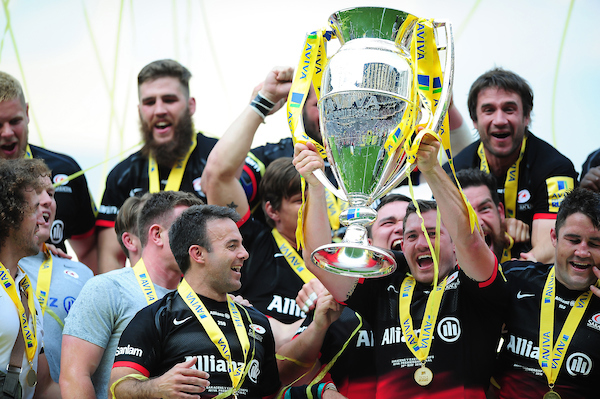
There has been a lot of talk this season about rugby’s messy schedule. Concerns over a lack of alignment between the hemispheres, internationals in the middle of the season, the sheer number of games players are involved in and the length of the Six Nations tournament are all concerns for the men at the top.
Sir Clive Woodward recently proposed a five-week tournament, in order to better mirror the knock-out stages of a World Cup. There is also a concern that the tournament – and international fixtures generally – robs the Premiership clubs of their players for too long.
Because of the added fallow weeks, that is seven weeks the clubs lose their top players over the Six Nations. There is a further four weeks over the Autumn Internationals, not to mention the various training camps. Most importantly of all, it equates to seven missed premiership matches. That is a third of the season and a possible 35 points up for grabs. To put that in context, Saracens finished last season on 80 points. 32 below them were Bath in ninth.
There was a stark reminder of the situation last weekend as Gloucester downed the defending champions Saracens, Sale defeated the current table-toppers Wasps, and Newcastle completed their double over east-midlands heavyweights Northampton Saints. Last week, second from bottom Worcester also beat Saracens. Back during the autumn series, Newcastle claimed an important win against Harlequins and that first against Northampton, and Wasps lost to Gloucester.
The clubs are financially compensated for the loss of their players – with a figure in excess of £200 million agreed between clubs and country – but there is still murmurings about devaluing the game for the fans, not to mention the ‘fair’ aspect; how can we have a tournament where the best teams lose their best players for a third of the matches?
Levelling the field
I will be honest – I don’t care. The crazy, messed up schedule with international players coming and going, is part of the reason I love the Premiership. It levels the playing field just the right amount and stops an elite few running away with it. Would Gloucester have downed a Saracens team featuring Owen Farrell, Jamie George and Maro Itoje? Would Sale have still beaten Wasps if they had James Haskell and Joe Launchbury starting? Maybe, but I wouldn’t bet money on it.
The bottom teams go into these matches with a glint in their eyes. They know the best are there to be beaten when they are missing those one or two players that separate them from the rest. It also means the best teams cannot rest on their laurels – during the internationals they are exposed and there is an opportunity, not just for their opponents, but for their rivals to gain ground on them. Leicester and Bath did exactly that last weekend.
The play-offs also take care of the ‘fair’ criticism to a certain extent. The occasional loss by the top teams does not necessarily cost them the trophy, they must instead ensure they finish in the top four and all is to play for come May. It may split the difference for a team with regard to fourth versus fifth, or a home or away play-off place, or indeed a spot in the Champions cup, but no system is perfect.
Exposure for young talent
Perhaps more importantly, it also is invaluable for bringing through emerging players. There is the Anglo-Welsh Cup and that plays a role in giving exposure to young players, but it is treated with such disdain by most clubs that often they are little better than b-fixtures anyway (it is why I didn’t include them when calculating missed games by the international players). They are definitely not the same as playing in a Premiership game.
Alex Lozowski is a perfect example. He kicked his heels on the bench at Wasps as Andy Goode, a flyhalf without the potential, but certainly with the seasoned experience, started ahead of him. Ironically it took him becoming understudy to a better player in Owen Farrell for him to get game time. Yes, Farrell was injured early in the season which got Lozowski some game time earlier than expected, but regardless of that he would have had at least seven Premiership games to show his potential – potential that has now got him on Eddie Jones radar and an England squad call up.
I understand the reasons people are calling for the rugby season to be changed – particularly when it comes to player welfare and the madness that the best players may have as little as six weeks off playing to let their bodies recover before preseason starts. And of course, this is a myopic Premiership centred view – it impacts some of the clubs in the Pro12 far more acutely (how are Glasgow expected to be competitive when they lose 15 players to the Scottish squad?).
But I for one like the chaos it brings to the Premiership. It creates the environment for giant-killings by the bottom clubs and the international stars of the future to get proper and sustained exposure to top level rugby. Everyone wins like this.
By Henry Ker
Very good article. Also, to counter Woodward’s point, IMO you NEED the fallow weeks for player welfare. Otherwise the players, particularly those in knockout stages of Europe, would never get a break. Also, Italy struggle enough in the latter stages every year (maybe this year is a bad example), I can’t see how removing the break will do anything other than hurt them more.
On the player welfare front, I suppose you could adopt a more extreme version of the (I think is it the Irish model), whereby all players are restricted in the number of games they play per season, thus still creating the same effects with players who clock up international games playing less for their clubs even if there is no overlap of games. You might have to build in world-cups/summer and Lions tours as exceptions outside the cap, but it might work.
As a London Irish fan I loved the Autumn International and 6 Nations (in the olden days when we were in the Prem.) . We quite often beat the big boys; we stood no chance during other times of the season.
On the whole I agree, but looking at the teams at the bottom rather than the top it could be seen as genuinely unfair rather than leveling the playing field.
If you’re a side at the bottom that gets to play several depleted teams during the internationals and pick up a few points, great. What if you’re the other side at the bottom that, through sheer bad luck, only gets to play teams not affected by call ups?
One benefits, the other doesn’t and it could be the difference in getting relegated.
Really good article and I agree with your points which further increase my love for the Aviva Premiership. It’s a fantastic competitive competition.