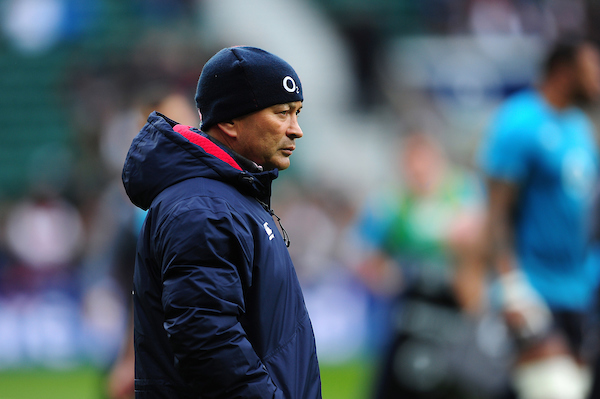
England equalled New Zealand’s record 18 game winning streak with their victory over Scotland. With the 2017 Six Nations trophy already secured, they can beat the All Blacks’ run if they go to Dublin and secure a second consecutive grand slam (the first team to do so in Six Nations history).
If you expected England to be in this position 18 months ago, having been dumped unceremoniously out of their own World Cup, well I expect you are enjoying your winnings from your 5000-1 bet on Leicester to win the Premier League and foresaw the Chicago Cubs ending their 108-year quest for a World Series.
That England’s new coach, Eddie Jones, has managed to turn that team into the one on the brink of history is an achievement of its own worth acknowledging.
Gameplan before players
If you look at this England side, you could be forgiven for your confusion. With a few exceptions, it is the same group of players who came short under Stuart Lancaster. Maro Itoje was still a teenager, and Ben Te’o and Nathan Hughes weren’t available to him. Elliot Daly is the exception – but he was deemed too risky a player.
Apart from that, England’s 23 last Saturday all featured regularly under Lancaster – indeed most, like Launchbury, the Vunipolas, Ford, Farrell, Watson, Nowell, Joseph and George, had received their debuts from him.
The difference was Lancaster was blinkered by a vision of an England team playing like All Blacks. He picked a gameplan first and tried to fit people into it, whether he had suitable players or not.
Robshaw is a prime example. I am not saying he did not have great games under Lancaster (he did), but he did not have the pace or breakdown ability to perform like a traditional openside, in the mould of Richie McCaw, David Pocock or George Smith. Lancaster refused to acknowledge this and kept trying to turn him into something he would never become.
Joel Tomkins and Sam Burgess are other examples – designs of an English Sonny Bill Williams led Lancaster to waste caps on players without the talent (the former) or the time and experience of union (the latter).
For a brief football comparison (sorry), look at Manchester City under Pep Guardiola. Guardiola came in with a clear vision of how he wanted to play – the way he had won multiple trophies with Barcelona and Bayern Munich. The issue is Guardiola doesn’t have the players he needed at City.
At a club you can change the players at your disposal. Guardiola needs a footballing goalkeeper who can distribute with both feet and set up attacking moves from the back. However, there was no one like that available. Man City ended up with Barcelona reserve Claudio Bravo – a player who in January had conceded 14 goals from the last 22 shots on goal. Yet Guardiola persevered with him (although he has since eventually benched him). Although they still sit in 3rd place, like Lancaster, Guardiola is blinded by desire for the perfect gameplan, and ignored that some of his players are not up to the task.
Players before gameplan
When Jones came in he cast his eye around and quickly evaluated what he had. He picked the best payers, then worked out a gameplan that would work to their strengths. Not the other way around. This was the benefit of the vast experience Jones has accrued over years at the top of the game. He signed George Smith to the Brumbies in 1999 so he knows a potential world-class openside when he sees one.
In Jones’ view, England had no traditional sevens. So Jones didn’t play one. Instead he moved Robshaw back to his best position on the blindside, and picked the destructive muscle of James Haskell in the 7 shirt – a player who admitted he felt like ‘a guilty secret’ under the previous regime. Rather than show him endless videos of McCaw, Smith, Pocock et al, Jones gave him licence to go and play like James Haskell. In other words, Haskell SMASH.
Similarly, Jones acknowledged a lack of powerful ball carriers in the centres (bar the perennially injured Manu Tuilagi). So out goes Billy Twelvetrees, Brad Barritt and Luther Burrell (well not quite, but more on that later). What he did have was an abundance of class fly-halves: guys like Ford, Farrell and Slade, and latterly Lozowski. Regardless of what you think of him, Cipriani still being deemed surplus to requirements shows the depth of the 10 shirt for England. So he picked two of them in Ford and Farrell, banked on their talent, their intuitive understanding of each other from schoolboy days and decided to work his gameplan around a twin-distributor axis in the centre.
Also at fullback. Although Jones has admitted he would like to try other players, such as Daly and Watson, in the 15 shirt, he picked Brown. He didn’t need Goode’s distribution skills with his Ford/Farrell partnership, what he needed was safety in defence and under the high ball. A fearless combatant that would organise the young wingers and carry the ball back time and time again without the slightest complaint. I will admit to criticising Brown’s lack of vision and aversion to risks, but you can be sure Jones has asked this of him. He asked Mike Brown to play like Mike Brown.
Reacting to mistakes
Jones hasn’t been faultless with his selections. As mentioned above, he briefly recalled Luther Burrell at 12. And asked Teimana Harrison to do a Haskell impression at 7. The difference was he quickly identified when these decisions had not worked and hooked the player before the match was lost. Burrell has since been jettisoned completely and although Harrison still remains around the squad, you feel this was in part due to lack of alternatives for Jones (he has picked Wood ahead of him recently).
This ruthless streak is also a clear differential from Lancaster. Lancaster always had the air of a kindly school teacher, and although he made some hard calls in his years in charge, he blindly persisted with players that weren’t going to cut it for too long. There is a fine line between patience and indulgence. Although I am not suggesting we should cast every player aside if they have a poor 20 minutes; the way Andy Robinson treated the 19-year old Matthew Tait after his humbling by Gavin Henson is a lesson in how not to treat a precociously talented young player.
However, Jones recognises that sometimes the most important thing is to win the game in front of you, and to do that sometimes you have to change a player.
Ultimately this run of games will be defined by the result next week – anything less than a new record of consecutive victories and a second Grand Slam will be deemed a failure in Eddie Jones’ eyes. However, it is worth noting just how far England has come. Of course Jones has brought so much more to England than I have just described – fitness, hunger and belief among other things – but the value of picking a gameplan to suit your players, rather than the other way round, cannot be overstated. Many top coaches could take notice.
By Henry Ker
Yes he is a top clash coach and tactician. He know the game inside out.Making average players look good and good players look great is what a good coach did.Alex Ferguson did it at Manu especially last couple of years Good luck Eddie!!
Lancaster may have had an ambition to play like the ABs but there was never evidence of gameplan to match, just lots of buzz words, “we want to play with pace, width and tempo”. After 4 years of “play for the shirt” we had actually lost the identity of English rugby.
Jones first asked himself “what is English rugby?”, which is big aggressive forwards, strong set piece, abrasive defence. He returned us to our traditional game and has then built on it.
Keeping the football comparison what Jones and Sir Alex share is an obsession and ability for getting the best out of each individual, figuring our how to motivate them, giving them the right work on areas. The players have responded to this far better than being treated like school children. Haskell feels the love, Billy feels empowered and more confident, Youngs has had a kick up the arse about being too tubby for a nippy SH and looks way sharper as a result.
Losing to Wales was the best thing that could have happened, we weren’t going anywhere under Lancaster. With another decade or so of top coaching experience Lancaster may be a top coach, but he wasn’t during his tenure with England and he failed to spot his fundamental weakness (experienced top level ‘track suit’ coaching) and bring people in to compensate for it.
I know it’s only a 4 year project for EJ and then he will be off, but what he’s imparting to the players and coaches will last a lot longer. Worth every penny.
What he’s imparting will only last if the RFU get their fingers out of their supercilious ar**s and build on the reforms and achievements made under EJ.
Last time after Clive Woodward’s reign they famously pi**ed away the legacy of Sir Clive thereby imposing a fifteen year period of rugby austerity (crap results and mediocrity)
The RFU turned on Woodward and wouldn’t sign up to his ‘vision of the future’ post world cup. Probably feared for their jobs and the scenario of them all having to kow tow to Clive in the corridors of rugby power.
If EJ wins the WC put him on the throne and give him a crown for all i care!
All hail Sir Eddie or is that king Eddie! Be good to have a bit of Aussie blood and dilute the Saxe-Coburg Gothas!
A good incisive article and I think an accurate summation. Look back before England however to Eddies last team, Japan, a team of lively small men, he knew they would never compete in a muscle game against South Africa so they avoided that contest, whipping balls in and back out of the scrum, result….we all remember, especially SA!
EJ has certainly done well with this English team but it is early days yet .
He failed miserably with the Qld Reds
maybe not his fault there was talk of a player revolt but we will see when the honeymoon is over
But he did succeed with Australia (a WC final runners up is arguably a success or at least a step to it..), Japan and now England.
I still bear a vicarious grudge against Andy Robinson for his piss-poor treatment of Tait. Throwing him in at the deep end was bad enough; leaving the poor bastard to drown when it became evident that he was not the Messiah is unforgivable. Completely derailed the career of a promising young player. If I were Tait, Robinson’s face would still have pride of place in the middle of my dartboard.
I appreciate this was only mentioned in passing in the article, but it makes me livid every time I think about it.
Same here… I think in terms of raw potential, he is one of the most talented backs England have ever produced. Then a mixture of poor management, being shunted from position to position and (more than anything) misfortune with injury mean Tait never really fulfilled his potential.
Slade and Daly are similar players, I hope they have a bit more luck!
Tait’s treatment by Robinson was certainly very poor, and to my mind there remains a question mark over Robinson’s man-management ability, as I am sure followers of Edinburgh, Scotland and Bristol (Ellis Genge???) would attest to.
However, that is Robinson.
Mathew Tait has had a decent career. We may think that he should have played more (than 38 times) for England, but the truth is, he has suffered a lot of injuries. We shouldn’t forget that he had a very successful career on the World Sevens circuit, and as Englands youngest squad member, he was arguably their player of the tournament in the WC2007. Less arguably the MotM in the Final!
So he may have been derailed in 2004, but he soon got back on track, and any perceived lack of “fulfilled potential” is surely more down to luck than Andy Robinson.
Its just occurred to me that there has been absolutely no discussion about how the other teams are going to place? I know no one really remembers who came 2nd, 3rd etc but its a great situation where only first and last place are confirmed, everyone else could come 2nd.
Scotland would need to thrash Italy by a lot to stand a chance. Ireland need to win to come 2nd, loose and they could end up 5th! We could end up with another amazing final day with teams all chasing final positions and see some big scores and hopefully very entertaining rugby!