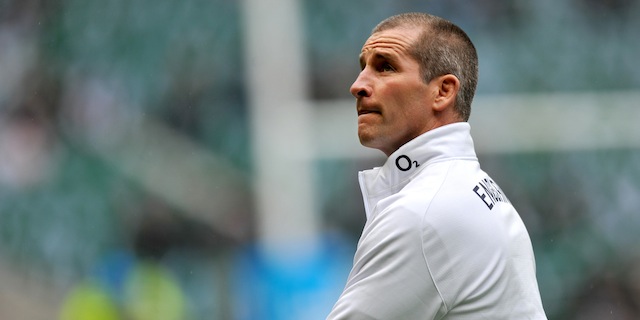
As Stuart Lancaster revealed his wider training squad for the Rugby World Cup later this year, much of the talk at today’s press conference surrounded who hadn’t been included: is this the definitive end of the World Cup road for the likes of Steffon Armitage and Nick Abendanon, based abroad in selection wilderness? And how much will Manu Tuilagi be missed?
The short answer to the first question is yes, although you’d be a fool to think that rumours and speculation wouldn’t abound in the months to come anyway. The answer to the second is tough to gauge given his lack of game time in recent years – but one thing that was utterly clear was Lancaster’s disappointment in Tuilagi’s behaviour.
Of course Lancaster’s flat rejection of Armitage and Abendanon will do little to quell the debate that has been raging around this topic for many years. The arguments have been made and rehashed so many times that it is scarcely worth laying them out again here – instead, it is worth considering a longer-term view.
If it proves that Lancaster will stick rigidly to the RFU party line – and rightly so – it was also illuminating to hear him speak of future challenges beyond the World Cup later this year. For most coaches, this World Cup is the be all and end all. But not so for Lancaster and his team.
When England won the World Cup in 2003 many expected them to continue to dominate the world game as they had in the previous cycle of four years. Instead, they finished 2004 with a win rate that was worse than half of what it was just a brief year before. A lot of senior figures, both players and coaches, had departed and English rugby was in a state of utter disrepair that few could have seen coming so quickly after the heady atmosphere of that famous night in Sydney.
Lancaster is a student of the game, and he knows all of this. What he lacks in top level playing experience, he more than makes up for in his attention to detail. And so when he says the likes of Armitage and Abendanon will remain in the international wilderness until they return to England, it is not merely him rolling over to the powers that be at Twickenham, but rather his genuine belief in what is best for the future of English rugby.
That responsibility stretches beyond 2015. Are Armitage and Abendanon currently two of the 50 best English rugby players? Undoubtedly so. But the damage that picking them would do to the future of England rugby far outweighs their worth for one tournament, only for them to swan off back to France afterwards. Lancaster knows this, and was at pains to point out that his job was to ensure that England remain one of the top rugby teams in the world not only now, in 2015, but also through to 2019 and beyond. Lessons must be learnt from 2003.
Frankly, all of this talk does a disservice to those guys actually selected. There are five uncapped players in the mix and an injection of youth further proves the point that this is a long-sighted squad selection – Henry Slade, Elliot Daly, Maro Itoje and Luke Cowan-Dickie will all play big roles in shaping England’s future, no doubt.
While it is unlikely more than one or two of them (Slade and Itoje look the most likely) will make the final squad, their inclusion at this stage will give them a valuable taste of the England environment that can only serve them well for the future.
And then of course there is Sam Burgess, whom Andy Farrell confirmed will be looked at in both the six and 12 shirts in training. That kind of versatility is unique and could throw a curveball into selection meetings nearer the time (picking him as a back-row option, for example, could allow England to select one fewer centre and bolster elsewhere, knowing that Burgess can cover if needed).
There are recalls for more experienced campaigners, too. For all the talk of the future, it is imperative that England perform well at their home World Cup, and the likes of Dave Strettle, Chris Ashton, Joe Launchbury and Alex Corbisiero all return to compliment the newbies. The balance between youth and experience is one of the most difficult to strike perfectly.
In terms of notable absentees, insatiably powerful Exeter back-row Dave Ewers is perhaps most unlucky to miss out, while Christian Wade continues to pay for his sporadic defensive lapses. Semesa Rokodoguni remains in the wilderness too, paying for poorly-timed injuries that have seen the likes of Anthony Watson and Jack Nowell cement themselves ahead of him. Jamie George can rightly be disappointed at his omission, especially after such a stellar campaign.
The walking wounded were also mentioned in dispatches by Lancaster and his coaches, with Tom Croft, Joe Simpson and Ben Foden all standing an excellent chance of making the final squad should they prove their recovery in time.
The squad will be moulded over the next few months; players will drop out, others will come in. None of them will be called Armitage or Abendanon, however – that much is abundantly clear, and hopefully that argument can now be put to bed. With one eye on the future and the other on the fast approaching home World Cup, England fans must hope that Lancaster has struck the right balance.
By Jamie Hosie
Follow Jamie on Twitter: @jhosie43
Photo by: Patrick Khachfe / Onside Images
7 replies on “Rejection of exiles shows Lancaster’s long game for England”
I do find SL’s position incredibly selfless. For his own benefit he could pick Armitage, get the media off his back and increase his chances of becoming a WC winning coach.
However, he continues to stick to the long term view on English rugby despite the fact that he may well not be involved at all. Fair play to him for that.
I agree and I can’t understand why he’s labelled as cautious when he’s involved way more youngsters than any other England coach I can remember. Yes he’s picked defence minded midfields at times, but when you consider tournaments won by defence minded international sides as opposed to attack minded ones it’s easy to make a case for this. We will see who makes the final squad cut and which XVs take the field. I’m excited already that’s for sure!
If England have a good WC, then Armitage and Abendanon will be forgotten, but if not….?
Maybe Lancaster’ll end up chatting with Ian Moores in some back of beyond ex cautious managers’ club.
Ian Moores? Is he related to Peter Moores?
I think Lancaster will have to win this world cup and the next one for the media to shut up about Armitage. Oddly enough, no one cared about Abendanon until he went to France. Then SCW started waxing lyrical about him, and suddenly Bendy is another France based player we absolutely have to pick.
Alan, I too wonder about Abendanon’s apparent canonisation this year. A very fine player undoubtedly but is there really a place for him in the England team?
To me, his moments of brilliance are too often offset by simple errors that would be crucified at International level. More so even than Euro Cup Final level.
Agree to an extent. IMO Abendanon can run @ the opposition almost too often, which can make him predictable @ times. However, he is positive & won’t generally kick the lard off the pill just because the heat’s on. Reminds me of Brown’s attitude, certainly a yr or so back anyway.
And he has thrived in France & can’t have made too many errors, otherwise he wouldn’t have got his gong.
Must have been thinking of his brother.