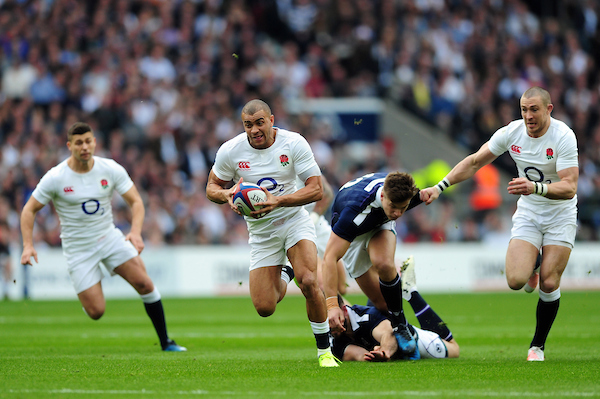
After an exhausting defensive effort earned England a narrow victory over Wales, next up is Scotland at Murrayfield.
Scotland have not been quite the force this year many expected, but after a humbling at the hands of Wales on the opening weekend, they fought back with a surprisingly restrained and pragmatic victory over the French, via Greig Laidlaw’s boot.
Seemingly borrowing the old French tagline, it is hard to decide what kind of Scottish team England will face this weekend. The swashbuckling marauders who smashed Australia and went so close against New Zealand, the shambles that were torn apart by Wales, or the calculated and clever team that snatched a late victory over Les Blues.
Scotland are always stronger at home, so I would be surprised if they capitulated in the manner of that Welsh defeat (or indeed, at Twickenham in the reverse fixture last year) – this will be a fiery and tight match between two bitter rivals.
Here are three areas for England that I think will be key to deciding the outcome.
The set piece
Scotland were sorely tested with their strength in depth at the start of the tournament, particularly in the scrum where they were without seven front row players. However, they stood up remarkably well given the situation, getting the ball out quickly to minimise scrum exposure. They are also boosted by first-choice tight-head props WP Nel and Zander Fagerson returning to training – with Nel pencilled in to play against England.
Meanwhile, Jones has said England are producing the best scrummaging performances of his tenure. This success pays a debt to Neal Hatley, England’s full-time scrum coach, and Marc dal Maso, the former France hooker who worked with Jones in Japan and is acting as a scrummaging consultant for England.
Alongside that, and following on from a similar session with Wales before the Autumn internationals, Jones has opted to have his team spend their rest week taking on ‘the biggest, ugliest, strongest scrum pack in the world’, or Georgia as they are more commonly known. Despite being a tier-two nation, Georgia is renowned as one of the best scrummaging teams in the world – indeed, an estimated 50 Georgian props play professional club rugby in France – and the two sides’ forwards had two days of full-blooded scrummaging and lineout work.
This is clearly an area Jones thinks England can dominate and I believe England will target Scotland severely at the scrum. With Nel’s likely rustiness (if he is parachuted straight back into the starting line up) or the inexperienced Simon Berghan at tighthead, and Simon McInally at hooker, England will fancy their chances at gaining the upper hand – particularly if they opt to unleash a frustrated Joe Marler, back from his latest suspension and raring to go. With the added ballast of Nathan Hughes at eight, expect to see that ball glued to his feet and England marching forward.
England were also looking at their lineout in the session with Georgia and we will likely see more aggressive lineout defence. The lineout is not Scotland’s strongest area – although bringing Grant Gilchrist back in has helped – and with three locks in Maro Itoje, Courtney Lawes and Joe Launchbury, not to mention George Kruis on the bench, England should have one of the most formidable lineout units in the world. Despite this, it has been noted that England have not competed as much on opposition throws in their recent games.
Given Jones’ stated belief that English rugby’s strengths are its set piece play, the number of excellent lineout forwards at their disposal, and a forwards’ coach who sees lineouts as his religion – not to mention Maro Itoje, who has a standing jump worthy of an NBA basketball player and the extendable arms of Inspector Gadget – it makes no sense for England not to turn the screw on Scotland here.
The aerial battle
It is very noticeable how much England have improved their kick-chase game – back in the autumn, particularly against Australia, Elliot Daly, Anthony Watson, Jonathan Joseph and Jonny May tore after each kick and competed or pressured the catching player, to great effect. Similarly in the Wales match, May, Watson and Mike Brown completely dominated the aerial battle. It was one such intervention leading to May’s first try and George Ford and Owen Farrell were constantly looking to test an inexperienced Wales back three with cross-field kicks.
A lot of this looks down to Neil Craig. Craig was recruited last October as England’s head of high performance; although his brief was more to improve leadership among the players, Craig had a 17-year playing career in Australian rules football. Following that, he spent seven years as head coach of Adelaide Crows, among other coaching roles. As one of the few cross-code stars between the two sports, Israel Folau is the poster boy for what rugby can learn from Aussie rules – namely that soaring leap, and Craig is clearly imparting some wisdom to England’s back three.
Stuart Hogg and Tommy Seymour are also strong in this area and it will be a fascinating contest. Especially now Greig Laidlaw has returned to the side, if Scotland opt for a tighter kicking game (maybe later in match, as against France), there will be a huge number of contestable kicks – but, with a little Aussie rules magic, one England will be confident of winning
Defence against counter-attack
Scotland rely on a very open gameplan, and always look dangerous on the counter, with players like Finn Russell, Stuart Hogg and Huw Jones capable of turning turnover ball into lethal attack.
Wales also employed a strong counter-attacking game and England needed a number of desperate last-ditch tackles to deny them scoring – Sam Underhill’s impossible tackle and flip of Scott Williams the best example. England looked a little lucky against Wales but, as the quote (dubiously attributed to golfer Gary Player) goes: the more I practice, the luckier I get.
Jones has been very open about the amount of time they spend on this practice, and his desire to make his side the fittest in the world. To this end, one of his key measurements is the time players spend ‘out of play’ – i.e. when they are on the ground and not able to contribute.
He is drilling his squad relentlessly and expects them to get back to their feet and into the defence exceptionally quickly. That said, it is still an area Scotland will test them in if they continue to adopt their brand of unstructured and chaotic rugby. Quickly reforming the defensive line and pressing hard – and creating their own luck – will be vital to stifling Scotland’s counter and prevent any break-away tries. Either that or start Sam Underhill from the beginning…
By Henry Ker
Where do you think the Calcutta Cup will be won and lost?
Eddie Jones’s biggest asset is his grasp of detail in competitive sport. Townsend’s biggest asset is counter attacking defensive structure. Who will win ? Townsend’s game plan is worth praising when he wins, but against teams at the top echelons of Rugby ( NZ, England ) you need more. England will win but virtue of a strong bench, strong ball carriers ( Robshaw, Hughes, Vunipola ) and ensuring clean ball out of the breakdown which has been the key to their success. Scotland have to disrupt clean ball to stand half a chance.
Whilst I think Eng will will comfortably, I think the first area is slightly wrong. I’ve just rewatched the scrums from both Scottish games and they actually had good parity with the French and Welsh. I don’t think the Scottish scrum will capitulate as described, and I would expect similar parity against England. That being said, I do think England’s pack will be able to deal with lineouts (either strong countermaul or Maro to steal). However, where the England pack will shine is in general play, where their fitness will prove the key difference – or realistically the relative lack of fitness from the Scottish forwards will cost them the match.
Also think that the Welsh back 3 made us look good by not being competitive in the aerial battle; I don’t think the difference will be that great in that domain.
Totally agree with the last area, generally English fitness will allow the team to cope against the Scottish attack, plus close out the game/pull ahead in the last 20 mins a la NZ.
Do you remember in the 2003 World Cup, when Georgia famously only had one scrum machine in the country. How times change.
And they weren’t too shabby at scrummaging even then!
Goes to show that a scrum machine is a piss poor substitute for a live opponet who will try to twist and pull you around to gain the upper hand
Exactly!