
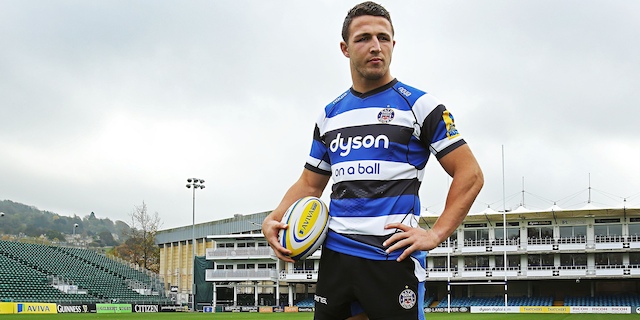
It’s easy to be cynical about a player’s intention when they move from League to Union, and the issue of money is often quick to raise its head, especially from the code having another one of their products poached from them. However, with Sam Burgess, talk of that nature has been minimal, and he’s received goodwill almost solidly across the board since the announcement of his transfer to Bath.
You see, Sam Burgess has always been different, and there’s always been an undeniable notion that in whatever he turned his hand to, he’d no doubt be a success. The combination of Sam Burgess the player – the forward as quick and intelligent as a back and a back and strong and tenacious as a forward – and Sam Burgess the man – humble, unassuming and family orientated – has created a unique beast. Burgess will come to Union with not only the best wishes and highest of hopes from League fans in England, but in Australia as well.
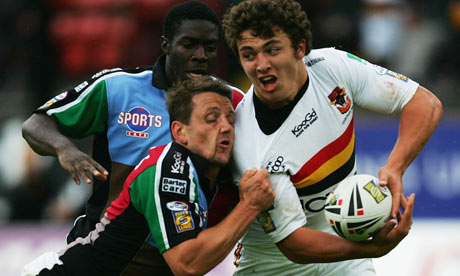 Since the start of his professional career at Bradford in the Super League, he’s shown his ability to adapt his game, raise himself for big occasions and lead by example. His debut at 18 couldn’t have come in a tougher fixture in the local derby against Leeds, but he didn’t look out of his depth for a second. In his first full established season in 2007, Burgess was voted the best young player in the league, and was called up to the Great Britain squad. Scoring in his first international game, Burgess became an overnight sensation at 19 due to a hit he put on rampaging Kiwi prop Fuifui Moimoi.
More solid performances for both club and country across 2008 and 2009 cemented Burgess as one of League’s brightest talents, and rumours of his departure from Bradford were picking up speed. Down in Australia with their higher crowds and, perhaps more importantly, their higher salary caps, several clubs were said to be interested in a still extremely young Burgess, and Bradford’s financial troubles wouldn’t deter them from selling. Behind the scenes, quite literally, South Sydney Rabbitohs majority shareholder Russell Crowe – yes, that one – was doing his best to convince Sam and his mother Julie (between takes on the set of Robin Hood) that his club would be the best place to be playing his rugby the next season. A mutual respect was instantly formed, and hands were firmly shaken.
Super League teaches a player many things, and helps forge some extremely key attributes in any rugby player’s game. To play Super League, a player has to be at the peak of his fitness, mentally tough, tactically aware and exceptional in both attack and defence. The pace of the game is relentless, the physicality is brutal and the pressure from fans on players at the bigger clubs is immense. Sam Burgess had taken that all in his stride before his 20th birthday. Perversely, had Burgess been older, he may never have become the player he is today. Rugby League in this country, even at the highest level, wasn’t even remotely close to being a professional environment.
Leeds Rhinos captain Kevin Sinfield explains it best when he talks about what he experienced coming through the ranks at Headlingley, and the changes that took place over the first few years he was involved in the first team. Unaware, or perhaps just pig ignorant, professional players were training hard during the day, but left all aspects of professionalism at the clubhouse door. There was an established and successful drinking and fast food culture, conditioning wasn’t a priority and players were essentially behaving as if they were part-timers. During the early 2000s when Sinfield was first made captain at Leeds, the culture around the sport began to change. Conditioning coaches were hired and players were properly educated on nutrition and fitness. Burgess came in to the sport at the perfect moment, and his attitude towards his own professionalism has a lot to do with the culture surrounding the sport shifting dramatically.
Moving to the NRL, the demand on him in every aspect would have been raised even higher, especially as one of few Englishmen in a league dominated by players from the southern hemisphere. His progression in Australia was slow, and the “all or nothing” way in which he plays the game took its tole on his body. Injury problems became an unfortunate regularity. Almost a blessing in disguise, Burgess took on his own conditioning work and came back from a lengthy lay off in the shape of his life, fitter, stronger and faster than he’d been previously, and fully intent on giving back to the Bunnies fans who had backed him.
Joined by his three brothers at the Rabbitohs, the Burgess family became an NRL sensation, both on and off the field. The popularity that Luke, Sam, George, Tom and their mother Julie experienced coincided perfectly with Sam hitting the best form of his career to date. Regularly swapping positions between prop, second row, loose forward and brief stints at centre, opposition teams were at a loss as to how to stop a man with his size, speed, skill and tenacity. All young rugby players – from both codes I imagine – are taught a lesson very early on about never taking a backward step, and never yielding. That lesson may well be taught in years to come by simply showing youngsters footage of Burgess playing.
In his final season in Australia he swept the board, winning just about every individual honour possible. Leading the Bunnies from the front, South Sydney became NRL Premiers for the first time in 43 years with Burgess putting in another man of the match performance in the Grandfinal, an achievement made all the more impressive after it came to light that he’d broken his cheekbone and eye socket in the very first tackle of the game. Burgess quite literally gave his blood, sweat and tears for the club, the fans and his teammates, and you can’t help but believe him when he says that he doesn’t regret any of it for a second.
With his move to Union in mind, it’s also worth taking into account the tournament experience that Burgess has internationally, haven already competed in a World Cup on home soil. He was exceptional in an England side that grew in to the tournament, crashing out in heartbreaking circumstances in the dying seconds of a semi-final against New Zealand, a game that should have been seen out. What he’ll have learnt, away from the crushing disappointing of what it’s like to fall short at the final hurdle, is how to behave in a tournament environment, what to expect from specialised training camps and how best to stay focused during that period. Should he make the England squad for the 2015 World Cup, he’ll be ready for everything that’ll be thrown at him, both on and off the field.
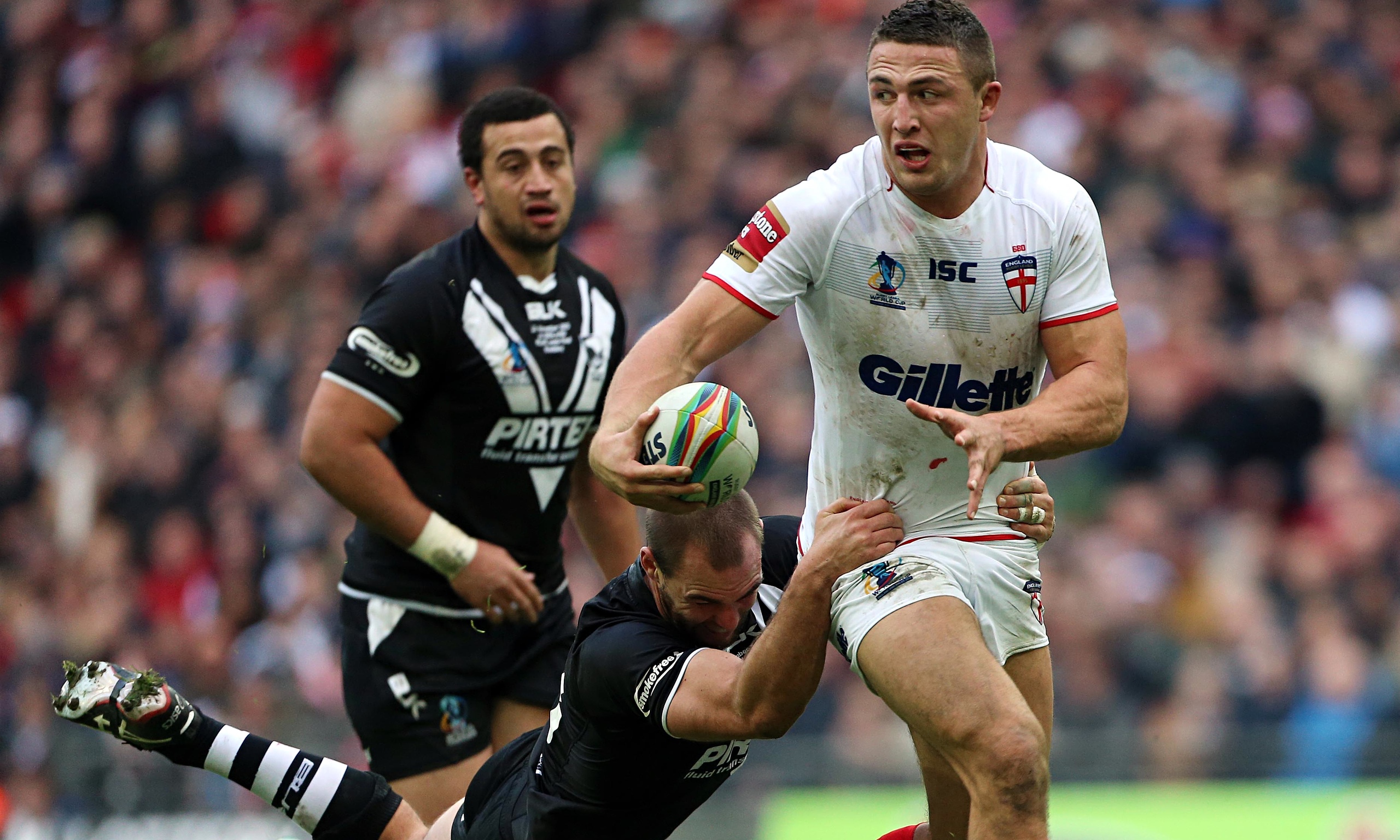 Success, of course, isn’t down to just ability alone. There are always players around who have the very basic ingredients required to become a top professional, but lose their way because their application and mentality aren’t befitting of somebody willing to challenge themselves and push their limits as far as they can go. Sam Burgess is single-minded and driven in a way that his peers can rarely compare to, and he manages to marry that with a level of natural modesty, charm and charisma that helps endear him to the public. The way he forcefully strives for success in his professional life can be compared to somebody like Cristiano Ronaldo, who is another athlete who has elevated himself above most of his peers through hours of hard work and a winning mentality.
The humble nature of Burgess is much more than a front, though. After his parents’ separation, Sam stayed with his father and hero, Mark, and was by his side for the entirety of his life-ending battle with motor neurone disease. At only 17-years old, whilst juggling a burgeoning first team career with the Bradford Bulls, he rose to challenge of being his father’s carer at home. He’s spoken about how it felt to carry his father up and down flights of stairs as his health deteriorated, and how, to some extent, his relocation to Australia was a symbolic fresh start. If there’s only one thing Burgess puts before his career, it is his family, and nobody can deny him that. To this day, Mark Burgess remains an honorary member of South Sydney Rabbitohs at the behest of Russell Crowe, and the seat beside him at the ANZ Stadium is left empty as a sign of respect.
Rugby Union, then, can await the arrival of not only an exceptional player, but an exceptional man. There are, no doubt, some technical aspects of his game he’ll have to tweak to fall in to line with the fifteen man version of the game, but none of those are too drastic. His ball carrying style and arm will have to be adapted to anticipate mauls and steals, he’ll have to learn how to take a tackle in such a way that recycling the ball doesn’t become a rain of studs and a chore. His penchant for sweeping onrushing attackers off their feet with a swift swing of his shoulder will have to be completely eradicated, and he’ll have to learn to always be seen to be using his arms to grapple in a tackle. His temperament needs a little work too, what constitutes a stern talking to from a referee in League for aggressive behaviour can often lead to a card of either colour in Union, which will obviously need to be avoided. These are things, though, alongside the more nuanced rules of the game, that Burgess is likely to pick up fairly quickly in the safety of a training field.
One of the largest discussions surrounding Burgess since the announcement of his move to Bath is that of which position he will in the fifteen man game. From a League perspective, and from the perspective of somebody who has played both codes at a competitive level at one time or another, it’s imperative that Burgess is given as much time with ball in hand as possible, and is stationed in the best possible area for him to get through defensive work. However, with Union, and the nature of the way possession is recycled, forwards tend to get bogged down doing the dirty work on the deck at rucks and packing in at mauls, and that would be a waste of talent where Burgess is considered. For a warning of how mistreatment and mismanagement could lead to the waste of a supreme talent moving from League to Union, one doesn’t need to look much further than Andy Farrell.
Conversely, you shouldn’t have him too wide, either. If his role is limited and possession doesn’t find him regularly, then his effectiveness is greatly harmed. To start with, ideally, the best place for him to play would be what League call the loose forward position, and what is a Union number eight. Allow him to share the defensive workload and use his size and power to stop oncoming sides, and be safe in the knowledge that he’s an athlete capable of completing 80 minutes with ease, so his attacking contribution won’t be hampered either. A lot of comparisons have been drawn between Burgess and Sonny Bill Williams, and rightly so, but there are intelligent, nuanced elements to they way Burgess plays and the rugby brain he has that Sonny Bill lacks. Burgess is the man you look to for leadership by example, and he can’t do that if he’s in a position where his effect on the game is limited.
Sam Burgess is a man ready to become a superstar in a second sport, and I’d bet my last penny if I could that he’ll do everything in his power to be in an England shirt at the soonest possible opportunity. It wouldn’t surprise if before long, Burgess is the pin-up for the RFU, as he’s got the personality that goes hand-in-hand with what is needed when being interviewed. There’s more than a small part of me that hopes, somewhat selfishly, that Burgess will one day return to the thirteen man game when he’s ready, but in the meantime, I, just like every other League fan going, only want the best for him in whatever he does in the other code. Special players like Sam Burgess don’t come around at all often, and it’s a privilege getting to see them in their prime when they do. He’s a talisman, he’s totemic, he’s iconic, he’s inspirational and now, rugby union, he’s all yours – just make sure you do your best to enjoy him while he’s around.
By Raj Bains
You can find Raj on Twitter: @BainsXIII

I can’t wait to see him in Union. Not long now I hope. Really hope he takes to the sport quickly. Could see him on the bench for 6n to ease him in.
I’d be surprised if he managed to play in the back row, mainly for breakdown reasons. It’s pretty tough to pick that stuff up to an international standard. Surely centre is the best bet? Get his hands on the ball as much as possible, let him defend. But if he becomes a forward he’ll have to learn to ruck, maul, scrum and be part of a line out – huge task.
He’d have been pretty useful outside Eastmond on Saturday to help England get over the gain line – can not wait to see him play.
Awesome article, thank you
I guess number 8 may not be such a bad idea if he can pick it up quickly. You don’t often see Kieran Read scrapping on the floor and he tries to avoid being caught up in rucks too much as its not where he’s most effective.
He’d need to a lot of practice at the back of the scrum though
I think Jacob is correct though – if we want him bought through quickly centre is the best position and probably inside centre, where he’s closer to the action
I imagine SB will play centre in his first season, to learn the basics (and it is his only chance to break into the world cup squad) then move to 8. If Youngs can move from centre to hooker in a couple of years, someone of Burgess’s talent should not find it hard.