
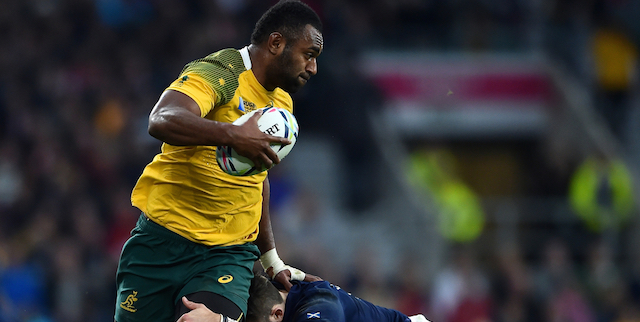
In certain positions, the World Cup has ushered in a new era of rugby union. Teams without a fetching seven are desperately scrambling for one. Long-armed locks are also in fashion in order to put a stop to the growing dominance of rolling mauls. But one area continues to cause debate: the midfield. Is it best to use a distributor at 12, or a wrecking ball?
When you select a distributor at inside centre, you are sacrificing a bit of defence but improving your attack, in general. The idea is that the fly-half feeds the 12 who who hits players outside him in a wider position. In theory, these players should then be running at the much smaller outside backs.
If you choose to go down the wrecking ball route, you should have a sturdier defence but your attack will be more one-dimensional. A wrecking ball 12 hits back towards the breakdown with the intention of breaking the gain line and halting the drift defence. Once he’s been tackled, the 10 should have an overlap to exploit.
DISTRIBUTORS
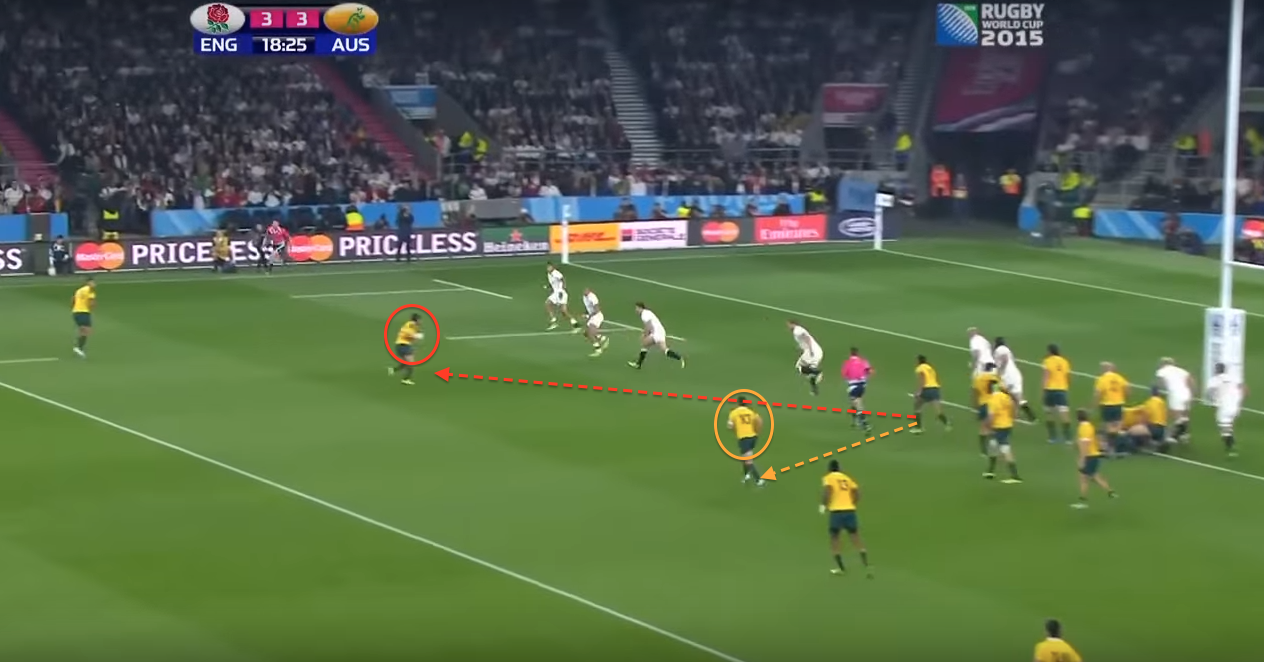
If a team has a distributor at 12, it doesn’t just mean that they can get more width into their attack, it also means that they can split their attack and spread the defence. In the following photo, Matt Giteau provides and option to the left and Bernard Foley brings himself and Kuridrani to the right. Will Genia goes left but Foley follows and provides and inside option for the 12.
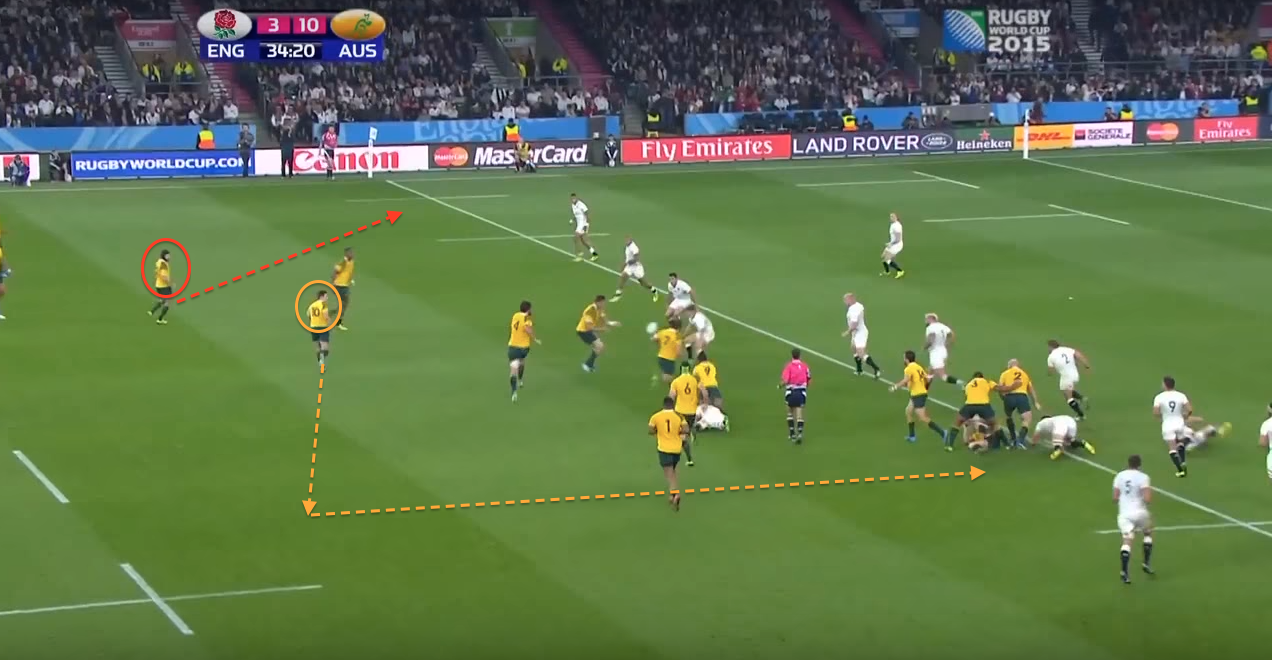
The next photograph below shows the lead-up to the Bernard Foley try against England, arguably one of the best of the tournament. Foley and Giteau both line up left, drawing the defence’s attention. Because the two playmakers are lined up left, England neglect the right hand side and that’s exactly where Foley turns to find a hole. Even once the defence realises that Foley is running a reverse line, they can’t all chase because Giteau remains on the other side and still represents a threat.
WRECKING BALLS
Jamie Roberts is the archetypal wrecking ball 12. Surprisingly, he started life as a winger and, contrary to popular opinion, he is an excellent passer of the ball. Wales do, however, use him most often for his gainline-breaking midfield ball carrying. In the below photo he takes a short crash ball from Dan Biggar. Warren-ball relies on winning the midfield battle and then exploiting the wings. On this occasion they do just that – Roberts takes the pass and heads back infield, thus stopping the English drift and allowing Wales to advance around the corner.
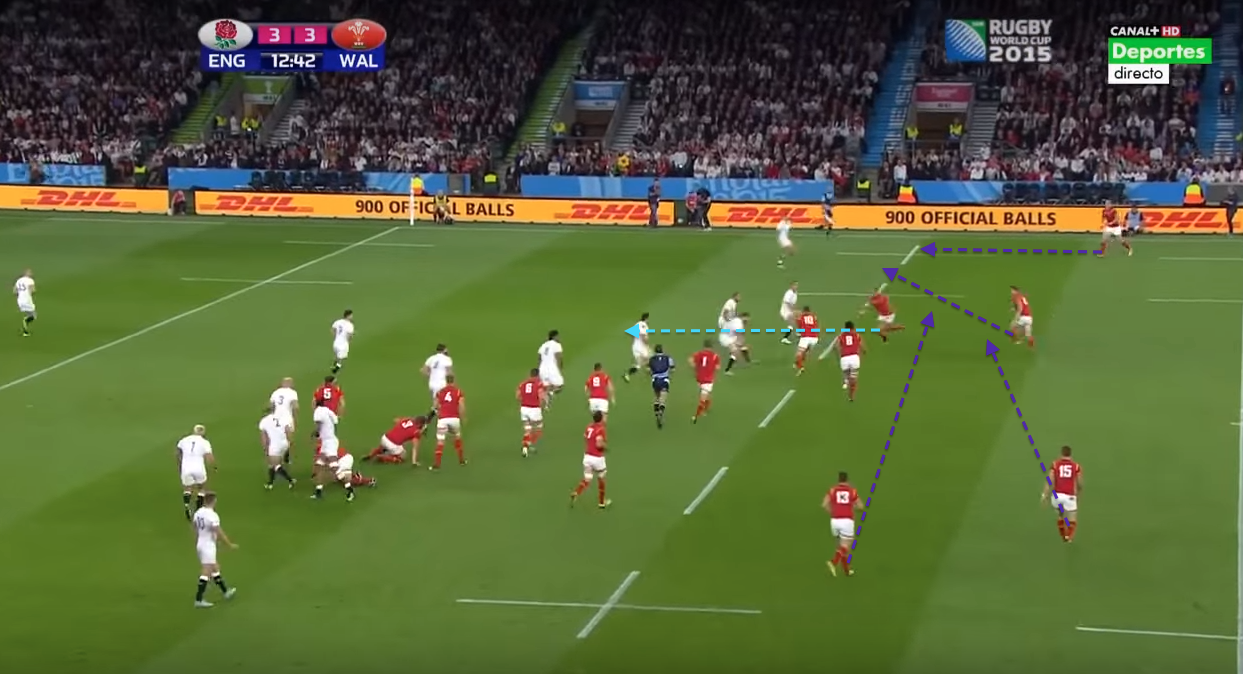
The inside centre, even those in the wrecking ball mould, still has the power to control a game. And with great power comes great responsibility. In the final picture below, Roberts has the ball and two choices to make: he either passes wide, or cuts back inside.
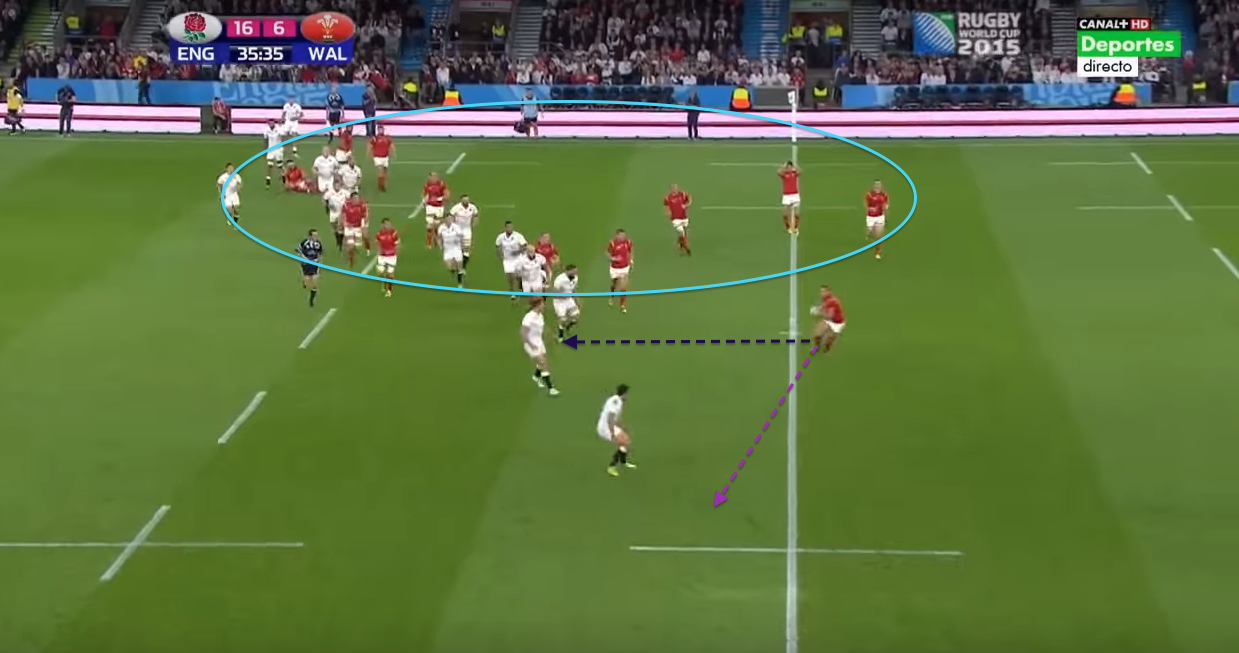
If he goes wide, Wales might get a massive gain but conversely if the winger is tackled, then it’s almost certainly turnover ball. Roberts plays the percentages and steps back inside, gains yards and allows Wales to continue attacking. A player more inclined to distribute, such as Giteau, might have trusted himself to make an accurate pass and gone for the wide option.
It is tempting to say that the a distributing 12 is the best option because it fits into how we all dream of playing rugby; width of the field attacks and creativity reigning. But it is easy to get carried away and look to do this too early, which can end up making your attack lateral and easy to read.
In the end what all great midfields have is a balance. In truth, whoever players 12 should have the decision-making ability to know when it is right to distribute and when it is right to simply truck it up and make the hard yards. Regardless of physical attributes, it is the top two inches that make a great inside centre.
By Sam Larner (@SamLStandsUp)
This is something of a World Cup-hangover article. We will be continuing this analytical series throughout the season, focussing on games that have been played more recently. If you would like a specific tactic or area of the game explored, please comment below and we’ll will try to deal with it soon.
Photo by: Patrick Khachfe / Onside Images
 As you know by now, we are hilarious, and you should be following us on Facebook and Twitter.
What you have to respect about a player like Nonu is that he started off as a wrecking ball and then developed such a good distribution game, with hand and foot. I think the ideal is to get to a level and a style of play where you have these multi-faceted players who can do a bit of everything. I think De Allende of South Africa could go the same way. A direct runner who could develop into a top all round 12.
I think Wales and Australia are at either end of the spectrum (as highlighted) with Giteau and Roebrts, but they are both the best available players and the two have built their teams accordingly.
With our back 3/4 (if you include Joseph) and their pace, I think having a 12 who can stop the drift may be able to create more space for the outside backs then a second distributor. So I think we need to go with Burrell, Tuilagi or Eastmond, who can all threaten the line with the ball in hand (albeit in different ways) and create space for those outside them.
I’m with you on that Rob. I’ve always preferred the way the Kiwis have the big fella at 12 and the nippy playmaker at 13.
As you say, the direct threat at 12 frees up space for the quick lads on the outside. Having a playmaker at 12 is fine but often it ends up being far too lateral and allows the defensive line to shut down the outside space
Having someone hard to stop at 12 also tends to drag flankers into tackles and rucks near to opposition forwards where turnover threat is (or should be) more easy to neutralise
The ideal of course is a big lad who can pass the ball. Its worth noting that the Kiwis played Nonu as not much more than a crash ball runner when he first started earning caps and moulded him into the player he is now. Distribution can be taught – size and speed can’t
I wonder whether it would be worth England identifying a promising youngster – eg. Sam Hill, Harry Sloan or someone similar – and working on them as a long-term project.
Re your last paragraph – it’s a lovely idea, but I don’t think England have enough time with their players (or rather, can’t dictate to the clubs what they do with players) to ensure whatever they want to do with, say, Sam Hill, is seen through.
Eddie Jones may try to change this, of course!
That’s strange I thought I’d replied on here yesterday.
All I was saying that I thought Tuilagi would be the one England would try and use in the 12 shirt. With the likes of Hill, or even Burrell, as alternatives. I’d then be picking between Slade, JJ or Daly for the 13 shirt.
A Tuilagi/Slade midfield would bring a bring blend of power, pace and distribution.
How about Slade, Tuilagi, Joseph as 10/12/13? Distribution, power, pace and defensively solid.
Definitely a seriously good combo.
However, for all JJ’s strengths, he isn’t a second distributor or a wrecking ball. The playmaking responsibility really falls on the 10s shoulders when he isn’t there, and has Slade shown enough to suggest he is a top class fly half? Not so sure.
Not in the sense that he hasn’t had the chance (and in all probability won’t) for England, and Exeter have moved him around. I think he combines the various talents of Farrell and Ford and could be our best option at 10, making space for Tuilagi at 12.
Incidentally, with our lack of top wings at the moment I was envisioning leaving Watson out there and seeing what Daly can do at FB when Brown shuffles off. On his current form he at the very least is a viable alternative to JJ at 13, but deserves to be in the first 15…taking the ‘shoehorn your best players in anywhere’ approach.
If only we had someone like Sam Burgess!!