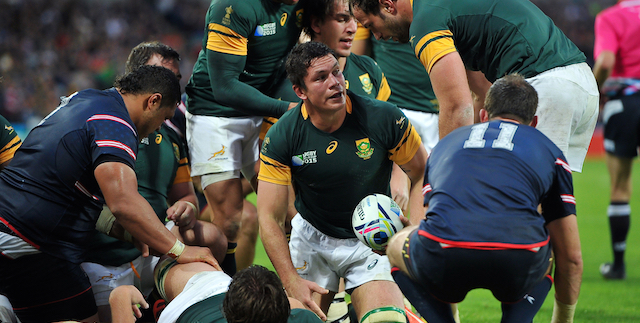
South Africa may started this tournament in the worst possible way, but with hindsight, the loss to Japan has seen the Springboks come back stronger and more galvanised than ever before. Heyneke Meyer didn’t panic after the opening weekend shocker, as he knew exactly what he needed to do to fuse his broken team back together.
Many will have looked at the resurgence of Bryan Habana or the renaissance of Fourie du Preez as the catalyst for their change in fortunes but the real plaudits must go to the one constant in the last three victories; the back row of Francois Louw, Schalk Burger and Duane Vermeulen.
In the ideal back-row, each player will have a defined role within your greater game plan. It is of paramount importance that there is a balance to the trio as well.
The Springbok three know exactly what their roles are and have managed to execute them with minimal fuss to not only disrupt and turnover opposition ball, but also provide quick and clean ball for Du Preez.
Let’s start with Burger, the blindside flanker. Once the bruiser of the back row, Burger has adapted his game with age. He no longer just smashes everything that moves; he is now the thinker in this unit.
He still adds considerable weight when carrying the ball, but he links seamlessly with the backline and has become a foil in attack. You won’t see Burger hitting every breakdown now, as he waits for the right time to hit the gain line, put people in a hole or offload behind the first line of defence.
The role of the hungry jackal that Burger has vacated now lies with Louw. His performance against the USA epitomised his job and how the rugby world perceives an openside should play, i.e. the classic ‘fetcher/gatherer’.
A nuisance at the breakdown and winning turnovers, Louw does offer more than; in the tackle he is aggressive and he rarely misses his man. It is Louw’s intelligence around the breakdown that is his most potent weapon, however. He is such a good reader of the game that he can decide when to steal the ball and when to force a penalty.
In open matches such as the USA game, Louw often stole clean turnover ball which allowed the backs dangerous broken field ball that led to significant territorial gains, and one of these turnovers set Bryan Habana away for the first try of the second half.
In tighter games, though, the West Country man tends not to steal the ball but rather take the sting out of the attack by clamping himself over the tackled player and forcing the penalty. He may not carry as much ball as his mates next to him do but that is not his primary function.
The final piece of this jigsaw is Duane Vermeulen. After a long injury lay-off, Vermeulen is certainly not back his best but the role he plays in this team is still invaluable. He has allowed Burger and Louw to do the jobs that are employed for merely by his physical presence on the pitch.
Again, Vermeulen has a skill set that most inside centres would cherish with his soft hands and ability to break the gain line, but his role at the breakdown and sheer bulk is the real reason that makes him the glue that holds this back row together.
Whilst Louw and Burger are scrapping on the floor, Vermeulen is protecting them, either by clearing out wannabe spoilers or just hovering over the top of the tackled player, deflecting anyone looking to steal Springbok ball.
When the ball is lost, Vermeulen assumes his position as first defender at the side of the breakdown. He is now the man that sets the defensive tone, often first out of the blocks and looking to make an offensive tackle that will allow Louw or any other fringe defender a shot at a turnover.
When looking back on this South African team in years to come we will all remember the defeat to Japan, that Bryan Habana (probably) broke Jonah Lomu’s try scoring record and that the Matfield/Botha partnership has been reincarnated in Eben Etzebeth and Lood de Jager, but spare a thought for these unsung heroes in the back-row.
People might pick South Africa’s number six, seven or eight in a World XV at the moment, but as a unit you won’t see many better at this Rugby World Cup.
By Andy Daniel (@scrum5ive)
Photo by: Patrick Khachfe / Onside Images
Yeah I think those 3 are going to be critical for us in this game.. I feel Wales will not have enough to counter them and believe Bokke will run out comfortable winners in the end. Weather is also going to be a factor, I am hearing reports of it potentially raining on the weekend.
Just to point out, we’ve not got a bad back row ourselves you know. Lyds is king of the chop tackle, TF can carry over hard yards and has a great offload, and Warbs is both strong in the loose, and a great leader. Plus we have Tips off the bench if / when the game breaks up.
For me, the key is more the front 5. Jenks can alienate a referee if he struggles at the scrum, and although AWJ and Charteris are fantastic players, they, for me, are off the pace off Jager and Etzebeth – as a pair they are on fire at the moment.
But with no disrespect to the teams in Pool B, have SA really been tested yet, even with the Japan result? If Wales get any form of platform in the set piece, keep ball in hand, and play with the ferocity of the last 2 weeks, who knows.
Yet more evidence that England need to revamp the back row and move with the times. No more “six and a halves”,we need proper scavengers and carriers who can also make the hits and pass the ball.
Rubbish. England need to sort out their entire breakdown strategy first.
They could have had Pocock or McCaw playing at 7 and neither would have made any difference to the results.
There is no one man messiah out there. The failings are mutual not individual
Doesn’t detract from the near as damnit FACT that England need a 7. INCONTESTABLE by now! If you’re a bemoaner of the loss of Robshaw (quite welcome to be) he can be a member of the bench!
My problem AlexD is we’re seeing the usual knee-jerk reaction from England fans and media. This belief that if only we had one different player everything would suddenly be ok.
Its balls.
England have fundamental problems with their strategy, style of play and therefore inevitably given the first two, their selection. One particular aspect of this is that their play at the breakdown has been, with one or two notable exceptions, awful – and that is the responsibility of the entire pack. Changing one man will make very little difference to this and will have made absolutely no difference to these World Cup results.
Get the foundations in place, decide upon strategy and a style of play and then choose the personnel that fits those decisions – and then, and this is key, stick with them and don’t suddenly change the entire style of the team in a panic
Finding a replacement for Robshaw at 7 is important (and by the way, it would be idiocy to jettison Robshaw completely) but its not even close to being the most important issue facing the England team
Pablito, I would say that the coach has to pick the best 15 available to him. He can’t afford not to. It used to be that he picked the best 15 and moulded the most suitable style to and around the players and their individual strengths not vice versa. It is normally COMMON SENSE who the ‘best’ are. With them in the bag (the bricks) you can build the house with the best materials (quality control perhaps). Bearing in mind this is a showcase of the ‘National’ house we’re talking about here not a two-up-two-down where the materials aren’t nearly as important and come second in the equation (money being the main factor – SL has no such problem as the RFU is stinking) Apologies for the home building analogy!
If Club coaches work like you are espousing fair enough but at National level I think not! The 15 or 21 should pick themselves whereas SL has clearly not been doing this (whatever the excuses – ref here to club v country)
We all know the obvious omissions and it amounts to the size of a virtual 2nd XV.