The other weekend, thanks to BT Sport, I got the chance to sit down with two of the voices of rugby, Nick Mullins and Ben Kay, and ask them about the work that goes into being a commentator.
What is the secret to great rugby commentary?
Nick Mullins: With radio you are describing a scene, but with television it’s adding something you cannot see. You have to enhance to the picture, add in the detail the viewer at home cannot get.
The best commentators are guys like Martin Tyler. You have to go through the gears in your commentary. Then there was Bill McLaren. Bill was brilliant, I learned everything from him.
A real danger for commentators is overselling the game. There are only so many times you can describe something as the ‘greatest match ever’. Always remember, the audience isn’t stupid, they love the game as much as we do. They have to trust you – and that trust is the key to commentating.
One of the loveliest things is to say nothing. Part of my job is to give Ben [Kay] and Austin [Healey] time and space to do their thing. Ben, Austin, Brian [O’Driscoll], Flats [David Flatman] – they all offer something different, and they are all brilliant.
You can’t be complacent either. I am always trying to improve.
Ben Kay: When I first started commentating, Nick told me it is like trying to have a conversation with your mum and Martin Johnson. One knows nothing about rugby, the other knows everything. You need to try and keep both involved in the conversation.
How do you prepare for a match and how long does it take?
Nick Mullins: Researching and writing up my notes for a match is a week’s work. I write down all my notes by hand to try and engrain them into my brain.
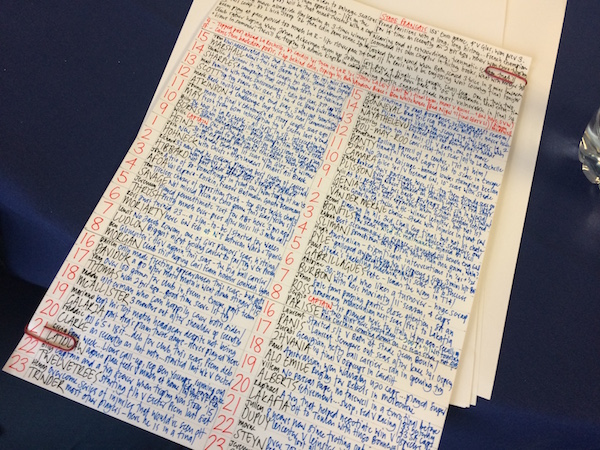
There are differences depending on who I am commentating for. Compared to, say, ITV, it matters less to explain the basics of the game when commentating on BT Sport, as it is a more of a rugby crowd watching. You are working to a different audience, who are watching because they love the game.
In terms of the information I try to give in my commentary, I am interested in the players as people. Rather than just giving the player’s key stats, I want to put the player in perspective. As I said, it is about adding to that picture.
Ben Kay: You have to remember your knowledge goes out of date. Even as an ex-player, I still need to speak to coaches and players to find out tactics and trends.
You put masses of information into your head about the upcoming match on the teams, tactics and facts. Then you almost drop it all and replace it for the next game.
Did you always want to become a commentator Ben, after you retired as a player?
Ben Kay: I have always wanted to do it. The reason is a lot of former players who become commentators can be quite negative.
That is because every time you watch the game as a player, you are searching for the negatives so you can address them and improve. That then carries over to commentary.
You can be guilty of downplaying brilliance – say, the fantastic footwork that led to a brilliant try – and instead focusing on the mistakes – a weak tackle or poor defensive positioning.
The mood of the commentators has an effect on the audience. So it was a decision for me to play and be a more positive commentator.
You see things differently now you are no longer a player. As a player or a coach there may be matches where you were convinced the referee had a bad game. A decision goes against you and it is hard to be objective. Afterwards you release you are being one-eyed. But as a commentator now I certainly see games a bit more fairly. And the standard of refereeing generally is so high nowadays.
Nick Mullins and Ben Kay were speaking at the Challenge Cup final at BT Murrayfield. BT Sport is the only place to watch rugby from the European Rugby Champions and Challenge Cup and the Aviva Premiership.
By Henry Ker