
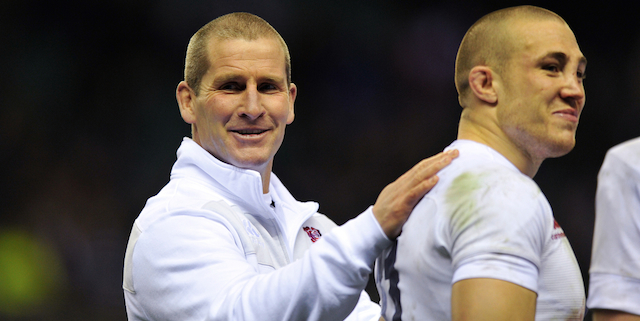
Two things immediately sprung to mind after reading this morning of the new, bumper, deal offered to Stuart Lancaster and his coaches:
1. It was shrewd of the RFU to give Lancaster et al their backing now, so they can relax and concentrate on the Rugby World Cup next year.
2. Hold on a minute, England are in an incredibly tough group – what happens if they are knocked out in the group stage of a home World Cup? Do the RFU stick with the deal or renege?
There are some precedents here. Before the 2007 World Cup Ireland offered Eddie O’Sullivan a new deal, only for them to fail to qualify from their pool (they had the hardest group in the competition that year – sound familiar?). The IRFU decided to clean their hands of him, despite a successful tenure leading into the World Cup.
On the other hand, you have the examples of Sir Clive Woodward and Graham Henry, who were both retained after disastrous World Cup campaigns (relative to expectations) in 1999 and 2007 respectively. Both went on to triumph in their second World Cup experiences in 2003 and 2011, seemingly vindicating the decisions of their employers.
The difference is that Woodward and Henry weren’t guaranteed security beyond their first World Cups in the way that O’Sullivan was, and Lancaster now is too. Their contracts were renewed after their initial failures, their unions looking long-term.
Whether that makes a difference or not we can’t really be sure, but the decision was made on the spot after the World Cup, not a year beforehand. The IRFU were left with egg on their faces after a show of such faith in O’Sullivan before the tournament, only for him to fail to deliver. They decided to save face and get rid of him, and yet the years since have hardly seen them make huge strides under new coaching regimes (although Schmidt is starting to change that).
Then there is Martin Johnson in 2011. England won the Six Nations that year (to date their only success in the competition since 2003), and the likes of Danny Care called for Johnson’s contract to be renewed before the 2011 World Cup. It has been well-documented what a disaster that was. The post-mortem was even more damning, and his dismissal was all but inevitable.
Which makes the RFU’s decision to offer a new contract to Lancaster, having been through that experience with Johnson, all the more telling. You cannot underestimate how big a show of faith it is in the current regime.
And here’s the thing – it doesn’t feel misplaced. ‘Culture’ and ‘philosophy’ are spoken of a lot in this business, but are mythical beasts to you and I, who have not experienced the very top level or rugby (or anywhere close, for most of us), but the way in which the current crop of England players carry themselves, the maturity they exude and the pride they have in playing for England, is evidence of progress under Lancaster. The rugby they are playing on the pitch, while also managing a respectable win percentage (the highest since Woodward) is further proof.
Martin Johnson spoke recently of warning his players of the ‘off-field temptations’ at the 2011 tournament, and yet there were still several high-profile gaffes that were played out in the media.
Of one thing we can be certain: the media scrutiny at a home World Cup will be even higher. Lancaster knows this, and whether or not he gets the message across better than Johnson did and they avoid the pitfalls of 2011, will be a true acid test of the ‘culture’ he has ingrained in the side.
For while it may not be something you can actually measure, if England lose to Australia and Wales, while still playing decent rugby and remaining on the back pages of the newspapers and not the front, then I think Lancaster and his team will be given the benefit of the doubt and allowed to see out their contracts and lead England to 2019 – and rightly so.
Is rugby becoming more attritional? It certainly seems that way. In the past week we’ve had news of long term injuries to Cian Healy, Geoff Parling, Alex Corbisiero, Keith Earls, Ken Owens and Ryan Bevington – and there are probably more I’ve forgotten. Add them to the already long list of those in the sick bay, and it’s not a pretty picture.
This weekend we see a replay of last season’s so-called ‘best test of all time’ between South Africa and New Zealand, and one man I feel sorry for is Wayne Barnes. That’s right, I said it. Nigel Owens was lauded after overseeing this match last season, and rightly so after he let the game flow.
It’s almost certain that this year won’t live up to last. While this is obviously down to much more than the referee, Barnes will still be feeling nervous about following in Owens’ footsteps – he’s never been as popular a figure as the maverick Welshman, and it’s tough to see how that can change after this weekend.
By Jamie Hosie
Follow Jamie on Twitter: @jhosie43
Photo by: Patrick Khachfe / Onside Images

I think it’s probably the right decision.
I don’t think England are likely to win the World cup next year, and they will be far stronger come 2019.
Ireland done the same with Eddie o Sullivan before 2007 wc and ended in disaster
I agree that it is the right decisions. I am under no illusions that England will win the World Cup next year. The optimist in me says that they could reach the final, but I just don’t think it’s possible to predict what could happen against Wales and Australia in the group stages. Yes, Wales 1-dimensional game has in theory been worked out, and yes, Australia are pretty inconsistent, but I am worried about the look of the England team come the group stages.
I think I’m just looking at how some players have kicked off the premiership and thinking – what is Lancaster going to go with? I think it’s fairly clear that he will stick with a backbone through the side of (forwards to backs) Hartley, Launchbury, the current back row set up (despite Robshaw and Harlequin’s current failings), Farrell (most likely), through to Brown at full back. HOWEVER, looking at initial form, who the hell goes every where else?! He has any number of options, tested and untested and not really enough time to settle. Following the New Zealand tour there was a lot of talk in the press of the ‘side that we should see in the World Cup next year’, but for some reason or another some of those players have dropped off. I guess I’m looking at Harlequins names more than others… Weren’t we expecting Yarde to thrive off the Quins game? Danny Care has been pretty anonymous? Joe Marler has had a questionable start?
Bloody hell, I’m really going for an essay here, but my point is, as has been mentioned various times, we have 10/11 internationals to go before the World Cup starts and a lot of players fading AND putting their hands up. I wouldn’t want to be Lancaster right now.
That said, looking towards future World Cups and international events, I feel like the stepping stones are definitely in place.
On another note, I am GUTTED for Corbisiery. One of the best looseheads in the Northern Hemisphere, if not the world, with the worst injury luck ever :(
It is easily forgotten that there was a general view, when Lancaster was first appointed, that 2015 was too soon but that 2019 was a great prospect. That still seems to be true. However well he marshalls and motivates his troops failure to progress beyond the group stage whilst hugely dissappointing would not necessarily be a failure on Lancaster’s part.
The availability and form of England players and the form and performance other teams, things over which he will have little if any control will also be major influences on England’s progress. On balance it’s probably the right decision. Lancaster doesn’t have a magic wand but he seems to be right much more often than he’s wrong and we can’t realy ask for more than that.