
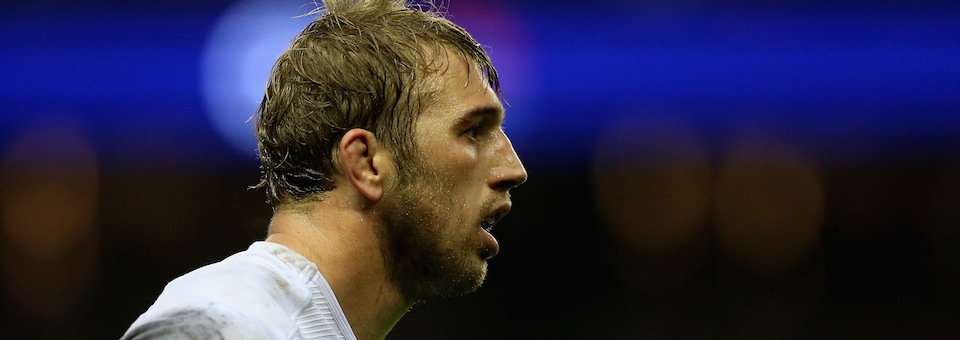
Much is made these days of the need for a ‘genuine’ no.7, someone in the mould of Australia’s David Pocock or Michael Hooper, whose primary focus is to win turnovers and disrupt opposition ball at the breakdown. We’ve taken a look at some data provided by Accenture to see how the current Northern Hemisphere open-sides are shaping up in the Six Nations.
Looking at Chris Robshaw and Sean O’Brien, in many facets the stats suggest they have been quite similar so far. In the two rounds of the 6 Nations to date, they have made 67 and 59 metres respectively – although the fact that Robshaw has actually made slightly more is surprising. Sean O’Brien is known for his carrying ability, consistently breaking tackles and making more obvious yardage. This stat is a testament, then, to the hard work that Robshaw does in the open spaces and as first receiver, where he often makes ground before passing.

This is backed up by the fairly astonishing statistic that Robshaw has made 17 passes to O’Brien’s three. The use of forwards as link men, and making sure they have the ability to be comfortable with the ball, is a hallmark of Lancaster’s playing style, and something that New Zealand have done consistently well over the years. Interestingly, the open-side with the next highest number of passes is Sam Warburton – in just one game. Make of that what you will.
When it comes to the breakdown, the stats are slightly more sobering. England have won seven turnovers of which Robshaw has won… one. Scotland have won 10 turnovers, with Kelly Brown contributing just two. Wales duo Warburton and Tipuric have won a grand total of zero between them, which is particularly surprising as they are probably the closest thing to a ‘fetcher’ that has has been on offer in the Six Nations.
As the famous saying goes, though, there are lies, damned lies and statistics. The men with 7 on their backs may not have been attributed with making many turnovers themselves, but there is more than one problem with taking that as read. Firstly, just because it didn’t go down as ‘their’ turnover, doesn’t mean they didn’t contribute. And secondly, for most of the players mentioned here their real value lies in other areas of the game. As we’ve already seen, Robshaw’s work-rate to get around the paddock and act as a link-man is invaluable. O’Brien’s barnstorming charges are vital to get Ireland on the front foot. Thierry Dusautoir is a leader of men (who shouldn’t be blamed for his team’s malaises) and gets through more tackles than most in a game. The same can be said of Kelly Brown.
The key word in all this is balance. What appears to be most important these days is having that balance across your back-row, or indeed across your whole team. Chris Robshaw may not have the breakdown abilities of a Pocock or McCaw, but in combination with Tom Wood and Ben Morgan, not to mention Dan Cole and Brad Barritt, England have a host of players capable of competing in the area. Likewise, Ireland’s Sean O’Brien can count on captain Jamie Heaslip and talisman Brian O’Driscoll to help him out.
The Northern Hemisphere’s open-side flankers may not be the best in the world at the breakdown, but they offer so much more than that. So while having a ‘fetcher’ in your team is undoubtedly a bonus, it is far from vital these days. If you want proof you need only look at England’s performance against New Zealand, when a back-row containing no genuine open-side dominated the best in the world in that position.
By Jamie Hosie
Follow Jamie on Twitter: @jhosie43
Accenture is working with the RBS 6 Nations to use technology to make the championship more interactive for fans by providing deeper insight into match data – follow @accenturerugby for all the latest stats and analysis.

Great Article!
For me its all about how the team wants to play, and the required back row balance to make this work, even how the whole pack works as a unit at the breakdown. As previously mentioned Lydiates absence probably plays a big factor in the ability of either Welsh 7 to perform at their best.
It also interesting to watch Dan Cole for England who is incredible for a prop at turnovers, i wonder how hard England work on getting him into those positions.
For me Robshaw and Wood are a great unit on the flanks, with Morgan when fit combining to make a very effective back row.
From a lions point of view the question is who out of the open sides will combine best with the other back rowers to create the best unit? given the candidates that’s one hell of a conundrum!
completely agree with you in regards to wood and robshaw. those two are the perfect combination for each other.
i think that if the lions want to do well, they should play wood and robshaw, or neither of them and go for something completely different.
my view is that wood and robshaw are so fit and mobile that they are probably one of the main reasons for england’s recent success. as many have said before, it doesnt matter how good a 7 is, if people get there and smash him off the ball before he gets to it, there is nothing he can do. that is why wood and robshaw are so effective.
i think those two have to be frontrunners for lions shirts, and SOB is definitely up there too. i think that SOB would be complimented quite nicely by a player like Kelly Brown, who goes about doing the less glamourous work, therefore giving SOB the chance to run and get the ball moving forward.
the likes of Lydiate and Ferris are very destructive and clearly out and out 6′s. i would play these guys with people like Warburton or Tipuric (or rennie if fit).
the lions backrow will be such an interesting area. i think the locks that are chosen will also effect which backrow is selected.
I’m sorry, Ronbraz, but have you not seen how Quins have been playing these last couple of seasons? Of all the teams in the AP, and arguably in the NH, they are the ones that are most willing to play a fast paced, open game. Robshaw as the Captain is keey to the Quins team as a whole, and as #7 and quite often as a first receiver as well.
The ‘out and out’ 7 nonsense was the fashionable gripe last year, and I think at last it’s proving to be utter rubbish. The more important point is balance as this article excellently illustrates – the game has moved on a lot since the days when just one player needed to be at every breakdown stealing the ball. Also, we’re allowed to have a different playing style in the Northern Hemisphere… Just because Richie McCaw and David Pocock do it, doesn’t mean we have to.
Tom Wood, Chris Robshaw and Ben Morgan are a fantastic back row unit but the point is made by the fact that Dan Cole is as active as any of them in stealing the ball – welcome to 21st century rugby.
Steffon who?
Not sure how you get more mobile than Robshaw and Wood. both have incredible engines and never stop going.
Quins play a fast,mobile game and it suits Robshaw down to the ground. They use him as first receiver a hell of a lot with runners playing off him and constantly looking for the off-load.
England are starting to play the same way, which is good to see.
As I’ve said before though, you can have the best open-side in the world and it will make no difference if the opposition gets to the breakdown in numbers and aggressively clears out. This is what the Kiwis have done so well for years. They don’t just flop over the ball at the ruck to protect it, but hit the ruck at speed and clear out any player near (and often not-so near) the ball giving them no chance to effect a turnover.
Likewise when they don’t have the ball – despite McCaw’s prowess he is infinitely helped by NZ counter-rucking. There is very rarely a ruck that isn’t contested.
England have started to play in the same way and with players like Robshaw, Wood, Cole, Parling and Barritt all contesting the ball, there is no need for a “specialist” 7
BTW – interesting fact from last week’s Telegraph. Apparently the player with the most turnovers in the Premiership is Billy Twelvetrees!
I noticed that too and did think it was odd that a centre had the most turnovers. Did you also see that he had one of the highest number of turnovers conceded as well? Bit of an odd one really.
Just look a sam warburton, he has joined the team and wales won the grandslam and came 4th in the world cup! (this will tell how important they are)
and yet cardiff didn’t do so much…
the welsh success came down to lots of different factors fitting together at once, not just the presence of sam warburton.
a backrow is about entirely about balance. wales did so well at that point because of the fantastic combination of warburton, lydiate and faletau. each bringing their own skills to the team.
its why backrows like Heaslip, SOB and Ferris or Wood, Robshaw and Morgan work so well. neither of these two teams have what is seen as a “genuine 7″ and yet they are extremely effective as a unit, because they compliment each other.
It is no coincidence that warburton’s lack of form for Wales has occurred whilst Lydiate has been injured
completely agree with you pablito.
the balance and combinations of a backrow are the key. not an individual player being a “genuine” in his position.
like i said in a post above, the combination of players can be the making of them. having seen how they play together, i would not want robshaw or wood running out for england without the other one (obviously excluding an injury) because they work so well together. if i was picking the lions team tomorrow, i would have both wood and robshaw, or neither of them.
one player being a “genuine” in their position cannot be the sole reason for a team winning or losing, it is the form, combinations and the balance of the entire team that affects the result.
I’ve actually just been looking at this issue in terms of a blog post I was going to do about the benefits of a genuine open side in lower level rugby.
I’ll link to this article during it because I don’t think you could have analysed much better than you have.
I’m a fan of proper open side flankers rather than the recessive wannabe number 8′s you can find at some clubs nowadays but that may be from the biased position of being an open side flanker myself!